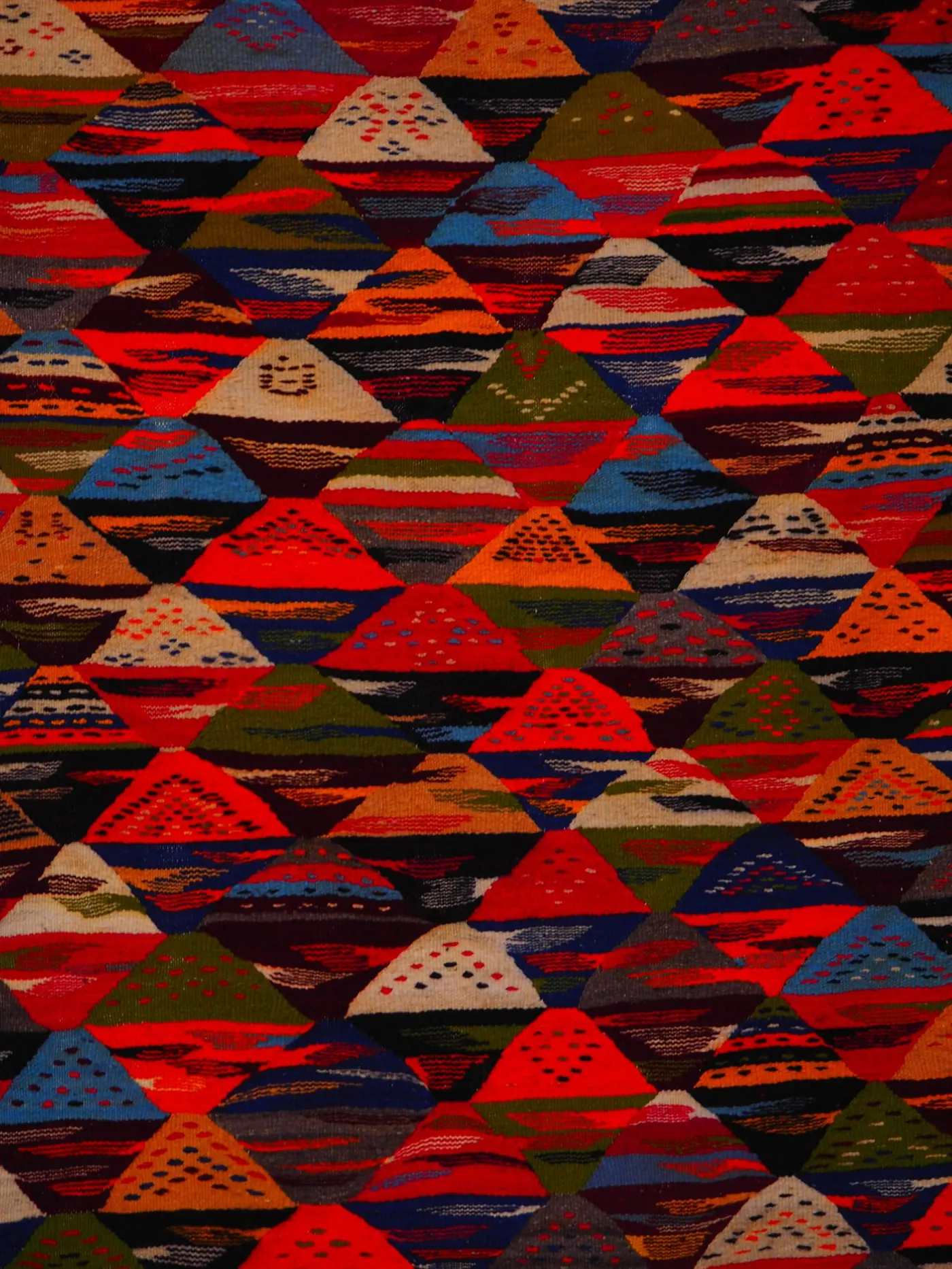
The kilim — the pileless, tapestry-woven rug of the nomadic world — is enjoying its strongest revival in decades. Interior designers from London to Los Angeles are layering kilims over sisal, hanging them as textile art and commissioning contemporary recolourings of ancient geometries. For a technique thousands of years old, it looks remarkably current.
What Makes a Kilim a Kilim
Kilims are woven, not knotted: coloured weft threads pass over and under the warps, packed down tightly so the weft alone forms the surface. The technique produces a flat, reversible textile, light enough to move and hang, with the crisp diagonals and bold geometry that discontinuous weft weaving naturally creates — including the small slits at colour boundaries that give "slit-weave" kilims their name.
Why the Revival, Why Now
Three currents converge. The flat profile suits modern practicalities — doors clear it, robot vacuums cross it, layering loves it. The geometric language pairs effortlessly with both minimalist and maximalist schemes. And the handcraft story — visible structure, honest technique, tribal lineage — answers the market's appetite for authenticity. Vintage kilims introduced the look; new production is meeting the demand vintage supply cannot.
Contemporary Kilim Design
Today's briefs recolour traditional motifs into terracotta, sage and oat palettes, enlarge single medallions into modern statements, or strip the vocabulary down to stripes and blocks. Wool remains the classic fibre; wool-cotton mixes lighten the price point; and chunky yarns push kilims toward the texture-first aesthetic.
Sourcing Kilims at Scale
Flatweaves reward manufacturers with strong dyeing (flat surfaces show every colour flaw) and disciplined finishing (edges and fringes take the wear). Both live in-house at our Bhadohi facility, where kilims and dhurries have been part of the loom mix for decades. See our flatweave collections or commission a recolour of a classic pattern for your market.